Why agents, not flows
· 2 min read · By ModuleX Team
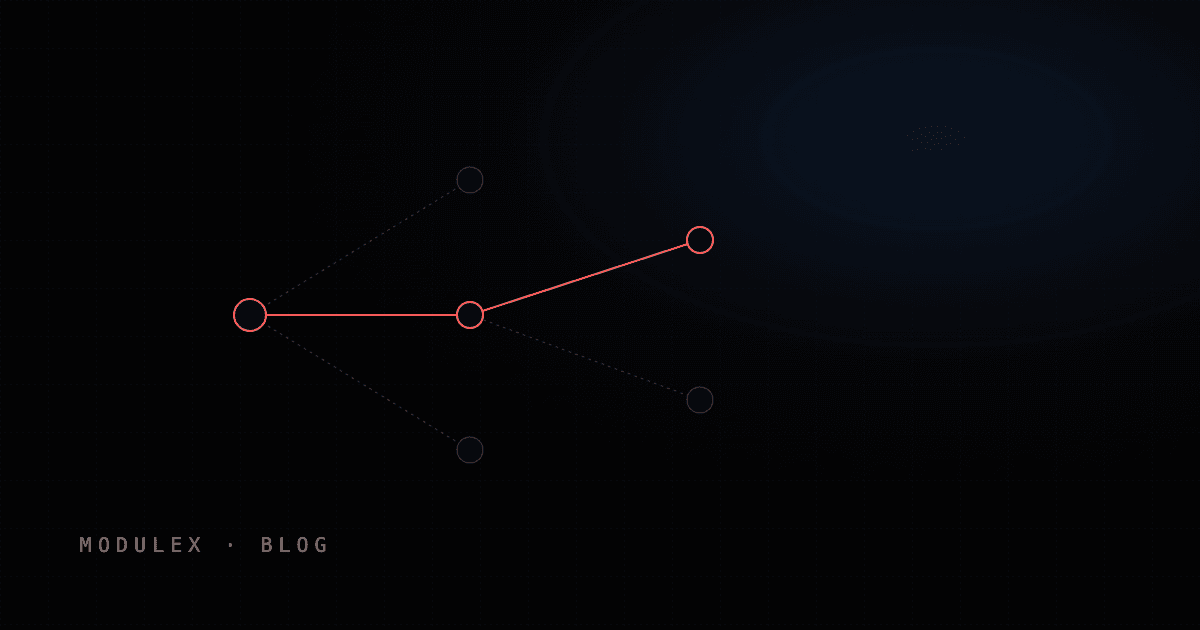
Classic automation is a diagram: a fixed set of boxes and arrows that you draw once and hope reality keeps matching. It usually does — until it doesn't. A field is missing, a record is shaped differently, a step needs a decision the diagram never anticipated, and the flow stalls or silently does the wrong thing.
We started ModuleX from a different premise: for a lot of real work, the right next step depends on what just happened. That's an agent's job, not a diagram's.
What an agent actually does here
When you give a ModuleX agent a request, it doesn't replay a fixed script. It reads the task, picks the right tool from your connected integrations — or chains several — and runs the actions with your organization's own credentials. Across the registry that's hundreds of real, callable actions, each one a concrete operation on a concrete tool.
The difference shows up in the messy middle. "Find the right record and update it" is one instruction to an agent and a small forest of branches in a static flow.
Agents are only as good as their guardrails
Flexibility is worthless if you can't trust it. So the interesting engineering wasn't "make an agent" — it was making an agent's autonomy legible:
- Tool-grounding. An agent can only do what your connected tools actually expose. There's no improvising an action that doesn't exist.
- Approvals. It can pause before sensitive actions and wait for a human.
- Run history. Every step is recorded — which tool, which action, what came back — so a run is something you can audit, not a black box.
- Your credentials, scoped. It acts as your organization, against keys stored encrypted and scoped to you.
When a flow is the right answer
None of this is anti-workflow. Repeatable processes deserve to be explicit, versioned, and runnable on a schedule — and that's exactly what the composer produces. The point isn't agents instead of workflows. It's that you shouldn't have to pre-build a rigid flow to do work that an agent can reason through on the spot, and you should be able to promote that work to a durable workflow when it earns the right to repeat.
Pick the tool that fits the task. We just made "the agent picks the tool" one of those tools.