From prompt to workflow
· 2 min read · By ModuleX Team
There's a familiar tax to most automation tools: before anything useful happens, you have to build the thing. Drag the nodes, wire the conditions, map every field. The work you actually wanted is hidden behind an hour of plumbing.
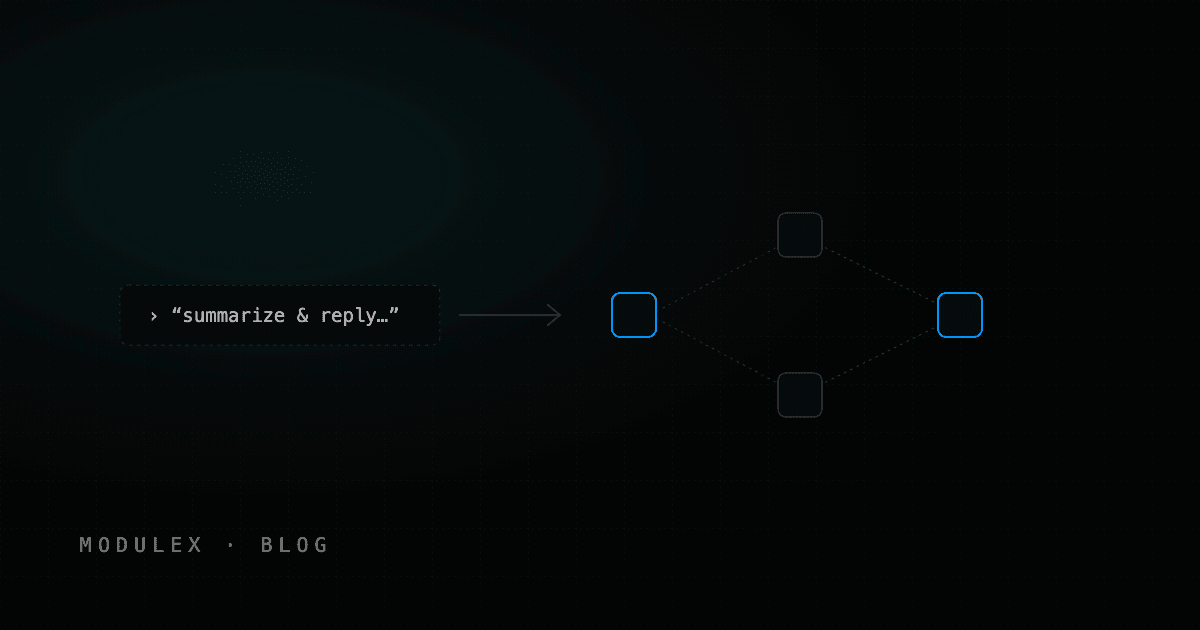
ModuleX starts from the other end. You describe the outcome in plain English, and the platform meets you where the intent is — not where the plumbing is.
Two ways in, one mental model
There are two ways to get work done in ModuleX, and they share the same idea: you say what you want, the system figures out which tools to use.
- Ask the assistant. Type a request and a ModuleX agent picks the right tool — or chains several together — and runs the actions using your organization's own credentials. No pre-built workflow required.
- Compose a workflow. When you want a process to repeat, describe it and the composer assembles an editable workflow graph for you, streaming the nodes onto the canvas as it builds.
The first is for the thing you need now. The second is for the thing you need every time. You don't choose a paradigm up front; you choose based on whether the work is a one-off or a routine.
Why "describe it" beats "build it"
When the description is the input, three things change:
- The blank canvas disappears. You're editing a real draft instead of starting from nothing.
- Tool choice is inferred, not configured. The agent maps your request to concrete actions across your connected integrations.
- The fast path and the durable path converge. A one-off prompt and a repeatable workflow are the same description at different lifecycles.
That last point is the quiet one. A request you typed to the assistant today is, almost verbatim, the workflow you'll want the composer to build tomorrow. Nothing is wasted.
What stays in your control
Inferring tools doesn't mean giving up the wheel. The composer's output is a graph you can read and edit on a visual canvas before you run it. The assistant can stop for approval before sensitive actions. And every run leaves a history you can inspect — what it called, in what order, with which result.
The goal isn't magic. It's removing the gap between I know what I want and it's running — without hiding what happened in between.
Describe the outcome. Review the steps. Run it when you're ready. That's the whole loop.